New South Wales · Corporate CBD offices
Sydney CBD Office Vending Machines: The 2026 Workplace Guide
Published 8 August 2026 · 1,214 words
The short answer
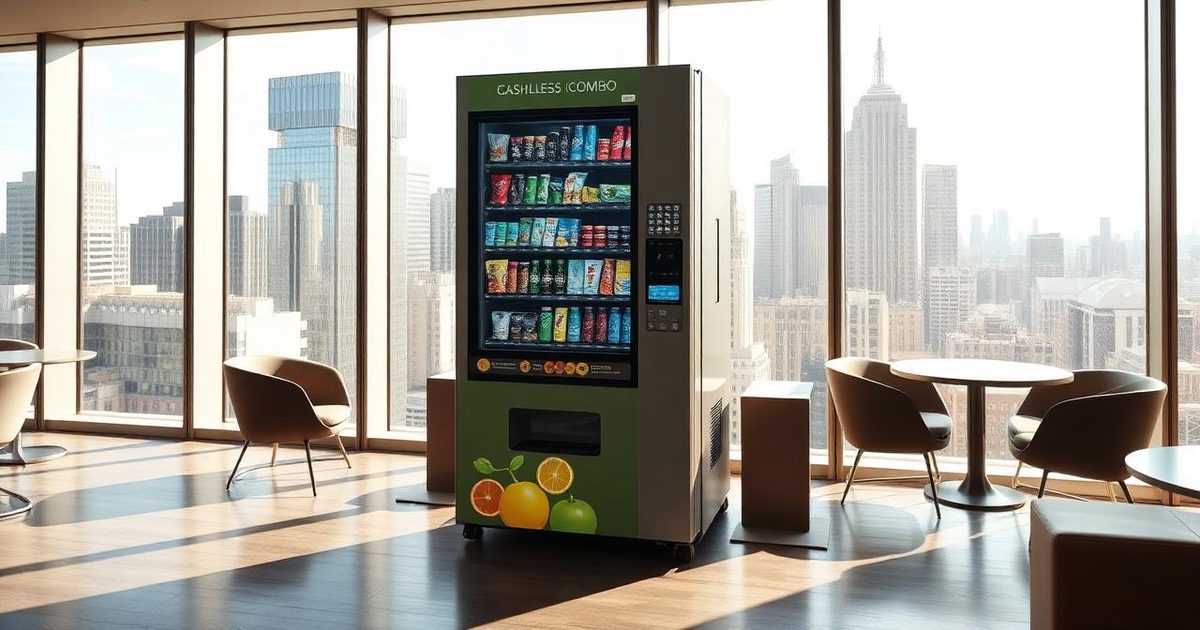
Sydney CBD offices pay nothing to hire a workplace vending machine under a $0 COST placement: a local owner-operator supplies, delivers, installs, stocks and services the machine, and the site provides about one square metre of floor space plus a 240V outlet. The only cost the tenancy carries is electricity, typically $0.35–$0.80 a day for a refrigerated combo unit. Sites from about 15–20 staff generally qualify, with installs commonly booked within a few working days.
Sydney's CBD has the densest concentration of white-collar workplaces in Australia, and the amenity expectations that come with it. Since the return-to-office push settled into hybrid patterns, workplace managers across Barangaroo, Martin Place, Wynyard and Circular Quay have been asked the same question by their teams: can we get decent snacks, cold drinks and coffee on the floor without another line item in the facilities budget? This guide sets out exactly how vending works for a Sydney CBD tenancy in 2026 — what qualifies, what it costs, how machines are sized to headcount, and what actually happens on install day.
What does a Sydney CBD install actually involve?
Almost nothing on your side. Once the site is confirmed, the local owner-operator books the loading dock with building management, provides their certificate of currency, delivers the machine on a trolley or through the goods lift and positions it where you have nominated.
The unit is levelled, plugged into a standard 240V outlet and the payment terminal is tested on the spot. The first planogram is loaded with you present, so the initial range reflects what your floor asks for rather than a generic template.
Grade A towers in the Sydney CBD often restrict deliveries to before nine or after four, which is the single most common cause of a delayed install. Confirming dock access early usually turns a fortnight into a few working days.
- Dock booking and installer insurance handled by the operator
- Delivery, positioning, levelling and power connection included
- Payment terminal tested before the operator leaves site
- First product range agreed with your team, not pre-set
- No trade work, plumbing or hard wiring required
How is the product range kept relevant over time?
Every machine reports what sells. The operator reviews that data on each service visit and rotates out the lines nobody buys, which is why most Sydney sites make one meaningful range change in the first month and then settle.
Requests from staff are the other input. A single email to the operator is enough to add a line, and sites with dietary requirements — halal, gluten free, sugar free or higher protein options — are usually accommodated within one restock cycle.
Because the operator earns from sales rather than a service fee, their commercial interest and your amenity interest point the same way: a machine stocked with what your people actually want.
How does free vending machine placement work in a Sydney CBD office?
Free placement — what we call $0 COST hire — means there is no purchase price, no lease, no rental fee, no insurance charge and no service fee. Machines Vending matches your site with a local vending machine owner-operator who supplies the machine, delivers and installs it, keeps it stocked and repairs it. The operator earns from product sales, which is what funds the placement and the ongoing vending service.
For the tenancy, the commitment is deliberately small: roughly one square metre of floor space, a standard 240V general power outlet within reach, and goods-lift or trolley access for restocking. There is no lock-in contract. If the site turns out not to suit either party, the machine is removed free of charge — with the honest caveat that a placed machine does need to make sales to stay.
In the CBD specifically, two building-side details matter more than anywhere else in Sydney. The first is dock booking: most Grade A towers require a loading dock reservation and a certificate of currency from the installer before delivery. The second is after-hours access rules, which determine whether restocking happens during business hours or overnight. Both are handled by the operator, but confirming them with building management early is what turns a two-week install into a three-day one.
- No purchase, lease, rental, insurance or service fee to the tenancy
- Owner-operator supplies, installs, restocks and maintains the machine
- About 1m wide x 0.9m deep x 1.83m tall, on a standard 240V outlet
- No lock-in contract; free removal if the site doesn't suit either party
- Dock booking and insurance paperwork handled by the local operator
What size machine suits our headcount?
Machine selection in a CBD office is driven by daily on-floor headcount, not lease headcount — which, under hybrid working, is often 55–70% of the badge list. Count the people physically present on an average Tuesday to Thursday and size to that. Undersizing produces sold-out selections by Wednesday afternoon; oversizing produces slow-moving stock and short-dated product.
| Daily headcount | Recommended machine | Typical range | Restock frequency |
|---|---|---|---|
| 15–25 | Snack & drink combo | Cold drinks, chips, chocolate, muesli bars | Fortnightly |
| 25–60 | Combo plus drink machine | Adds water, sparkling, energy, juice | Weekly |
| 60–120 | Drink + snack + healthy-first bank | Low-sugar, nuts, protein, baked snacks | Weekly |
| 120+ | Micro market or smart fridge bank | Fresh food, salads, sandwiches, barista coffee | 2–3 times weekly |
What does a vending machine cost a Sydney office to run?
The only running cost the tenancy carries is electricity. A refrigerated snack-and-drink combo draws 250–500W with the compressor cycling, which works out at roughly 1.2–2.5 kWh a day. At the commercial tariffs most CBD tenancies pay in 2026, that is about $0.35–$0.80 per day, or under $300 a year. An ambient snack-only machine is far cheaper again at 0.3–0.8 kWh a day.
Modern machines reduce that further with LED lighting, night-mode dimming and compressor idling outside occupied hours, which is worth specifying if your tenancy reports on NABERS or has an internal energy target. Remote telemetry also means the operator can see sales and fault alerts without attending site, so restock runs are scheduled against real demand instead of a fixed calendar.
Staff pay only for what they buy, at retail prices set by the operator. Where a workplace wants to subsidise refreshments, the common approach is a partial subsidy on selected lines — water and healthy snacks, typically — rather than a free-vend machine, which tends to see stock disappear faster than it can be replaced.
Which Sydney CBD workplaces qualify?
Placement is about foot traffic and dwell time rather than industry. In the CBD and the fringe precincts, the strongest performers are professional services floors, government departments, contact centres, hospitals and clinics, university and TAFE campuses, hotels and serviced apartments, and building-services teams in the larger towers.
Beyond the CBD core, the same offer covers the wider Sydney basin: Parramatta and the Western Sydney industrial estates, Norwest business park, Macquarie Park, Alexandria and Botany logistics, Silverwater manufacturing and the Sutherland Shire. Sites with shift work often outperform head offices, because the vending machine is the only refreshment option available at 2am.
- Corporate and professional services floors, 15+ daily staff
- Government and council offices, including secure and after-hours sites
- Hospitals, clinics and allied health with visitor traffic
- Universities, TAFE and student accommodation
- Hotels, serviced apartments and backpacker accommodation
- Warehousing, logistics and manufacturing with shift crews
Are the machines cashless, and what payments are accepted?
Yes. Every machine placed in a Sydney CBD tenancy is fitted with a contactless reader accepting Visa, Mastercard, Apple Pay and Google Pay, plus QR-code touchless payment. Cash is optional and increasingly declined by hosts, because it removes cash-handling risk from the floor and eliminates coin-jam call-outs.
Cashless also improves the service quality the site sees. Failed vends can be reversed from the transaction record rather than requiring a refund float, and the sales data tells the operator precisely which lines to expand and which to drop at the next planogram review.
How long does installation take?
Once the site details are confirmed — address, daily headcount, product preference and a contact for access — a Sydney CBD placement is usually installed within a few working days. The gating item is almost never machine availability; it is dock booking and site induction paperwork.
A typical sequence runs: site confirmed and machine matched on day one, dock and insurance paperwork lodged on day two, delivery and install booked for the first available dock window, and the first full stock load on the day of install. The operator then sets a restock cadence from the first two weeks of real sales data.
Frequently asked questions
Is a vending machine really free for a Sydney CBD office?
Yes. It is a $0 COST hire — no purchase, lease, rental, insurance or service fee. The tenancy provides about one square metre of floor space and a 240V outlet, and pays only the electricity, typically $0.35–$0.80 a day for a refrigerated machine.
How many staff do we need to qualify?
Generally 15–20 or more people on site each day. Count average daily attendance rather than total headcount, since hybrid working means CBD floors often run well below full occupancy. Quieter floors can still qualify when several tenancies share a machine in a common area such as an end-of-trip facility or ground-floor lobby.
How much space does the machine need?
Approximately 1000mm wide, 900mm deep and 1830mm tall, plus about 100mm clearance behind for airflow and enough front clearance for the door to open fully. Trolley or goods-lift access is needed for delivery and restocking.
Can we choose what is stocked?
Yes. You approve the planogram, including healthy-first ranges of water, low-sugar drinks, nuts, protein bars and baked snacks. Ranges are reviewed against sales data and can be changed at any time.
What happens if the machine breaks down?
Call the number on the machine and the local Sydney operator attends. Refunds for failed vends are handled by the operator, and cashless transactions can be reversed from the payment records.
Do you cover the rest of Sydney and regional NSW?
Yes. The same $0 COST hire offer covers Parramatta, Norwest, Macquarie Park, Western Sydney, the Sutherland Shire and regional New South Wales through the same network of local owner-operators. Placement and install timing depends on the local operator's run, so regional sites are usually scheduled alongside an existing service route rather than as a standalone trip.
Key claims, checked against sources
A refrigerated snack-and-drink combo machine draws about 1.2–2.5 kWh per day, so electricity is the only running cost the host site carries.
The machine plugs into a standard 240V general power outlet — no three-phase supply, plumbing or data cabling is required.
Sites from about 15–20 daily staff typically qualify for $0 COST hire placement through a local owner-operator.
Sources and further reading
- Machines Vending — free vending placement
- Vending machine power consumption guide
- Compare vending machine types
- Sydney placement coverage