New South Wales · Government departments, corporate offices and industrial sites
NSW WorkCover Ordinary Recess Claims: A 2026 Employer Guide
Published 8 August 2026 · 1,489 words
The short answer
In New South Wales, an injury during an ordinary recess — a meal or rest break — can be compensable under the Workers Compensation Act 1987 even when the worker has left the workplace, provided the absence was not for an unreasonable period and the worker did not voluntarily and unreasonably submit to an abnormal risk. That makes the daily walk to a cafe or shop a live exposure for Sydney and regional New South Wales employers, and it is one reason facilities teams increasingly keep food and drink available on site.
Every New South Wales employer knows that injuries at a workbench or desk are covered by workers compensation. Fewer are clear on what happens when a worker slips on a wet footpath halfway to a sandwich shop, or trips on a kerb crossing the road for coffee. The answer, under the ordinary recess provisions of the NSW scheme, is that the claim may well be accepted — and that the cost lands with the employer's icare policy and claims experience, not the cafe. This 2026 guide explains what an ordinary recess is, when a recess injury is compensable in New South Wales, what the practical management levers are, and where on-site amenity fits into a genuine risk-reduction plan rather than a marketing pitch. It is written for facilities, HR and WHS coordinators in Sydney CBD towers, Western Sydney warehouses and regional depots who have to make these decisions with real budgets.
What counts as an ordinary recess in New South Wales?
Most NSW WorkCover ordinary recess claims turn on one question: was the worker on a genuine break? An ordinary recess is a break in the working day that the worker is entitled to take: a meal break, a smoko, a rostered rest period. It is distinct from travel to and from work at the start and end of a shift, which is dealt with under the journey claim provisions, and distinct from time spent on an authorised work errand, which is ordinarily treated as being in the course of employment.
The statutory hook in New South Wales sits in section 11 of the Workers Compensation Act 1987, which deals with injuries during an interval or authorised absence from actual work. In broad terms, an injury during that interval can be treated as arising out of or in the course of employment unless the worker was absent for an unreasonable period, or the injury happened because the worker voluntarily and unreasonably submitted to an abnormal risk of injury.
That is a deliberately fact-sensitive test, and it is why two superficially similar incidents can be decided differently. A twenty-minute walk to a food court during a rostered thirty-minute break sits comfortably inside a reasonable absence. A ninety-minute detour to run personal errands during the same break does not. Employers who assume that leaving the premises automatically ends coverage are frequently surprised at the first insurer decision.
- Meal breaks, rest breaks and smokos are ordinary recesses, whether taken on or off the premises
- Coverage is not automatically lost because the worker walked out the front door
- Absences that run well beyond the rostered break can fall outside the provision
- Voluntarily and unreasonably taking on an abnormal risk can also defeat a claim
- Journey claims to and from work are assessed under separate, narrower rules
Why are off-site break injuries so common in Sydney?
Density is the simple answer. In the Sydney CBD, the nearest coffee is usually across a road, down a lift lobby, through a construction hoarding and back again — a sequence of pedestrian conflict points repeated by thousands of workers at eleven o'clock every weekday. In Western Sydney industrial estates the picture is different but no safer: the walk is longer, the footpaths are patchier, and the trip is often made by car through a truck-heavy service road.
Both patterns produce the same claim categories. Slips, trips and falls on external surfaces dominate, followed by motor vehicle incidents where a worker drives during a break, then minor impact injuries in crowded retail environments. None of these involve a plant hazard the employer controls, which is precisely what makes them frustrating to manage through conventional WHS controls.
For a self-insured or experience-rated employer in New South Wales, the financial signal is not the individual claim. It is the cumulative effect on claims experience, premium and lost-time performance, plus the administrative load of managing a claim where liability turns on how long a break ran and which route someone chose to walk.
How does a recess claim actually get decided?
The insurer works through a fairly consistent sequence. It establishes whether the person was a worker at the relevant time, whether the injury occurred during an interval or authorised absence, whether the length of that absence was reasonable in the circumstances, and whether the worker exposed themselves to an abnormal risk in a way that was both voluntary and unreasonable.
Evidence quality drives outcomes. Rostered break times, access-control records, incident reports taken on the day and a clear statement of where the worker was going all shorten the decision. This is also where a SafeWork NSW lunch break injury notification, if one was made, becomes useful supporting evidence. Employers who cannot produce break rosters or site access data usually find the benefit of the doubt runs the worker's way, which is a records problem rather than a legal one.
The table below sets out how common scenarios are typically approached. It is a general guide only — every claim is decided on its own facts and on current legislation and case law, and specific advice should come from your claims manager or a NSW workers compensation lawyer.
| Scenario | Typical treatment | Key factor |
|---|---|---|
| Trip on a footpath walking to a nearby cafe within a rostered break | Generally treated as compensable | Absence length was reasonable |
| Injury in the site lunchroom during a meal break | Compensable, and squarely an employer premises matter | Occurred on the employer's premises |
| Motor vehicle incident driving to a shopping centre mid-shift | Often compensable, but heavily fact dependent | Reasonableness of the trip and its duration |
| Injury during a two-hour personal errand on a thirty-minute break | Commonly disputed by the insurer | Absence well beyond the rostered period |
| Injury climbing a barricade to shortcut a closed footpath | Frequently declined | Voluntary exposure to an abnormal risk |
What can a New South Wales employer control?
Employers cannot control the public footpath, and no policy document makes a wet kerb safe. What they can control is how often the trip needs to happen, how well breaks are recorded, and how quickly an incident is captured while the facts are fresh.
The most practical levers are administrative. Publish break rosters and keep them. Make incident reporting available on a phone rather than a paper form in a supervisor's drawer. Brief supervisors that a recess injury is reportable even when it happened two streets away, because a late report is the single most common reason a legitimate claim becomes a contested one.
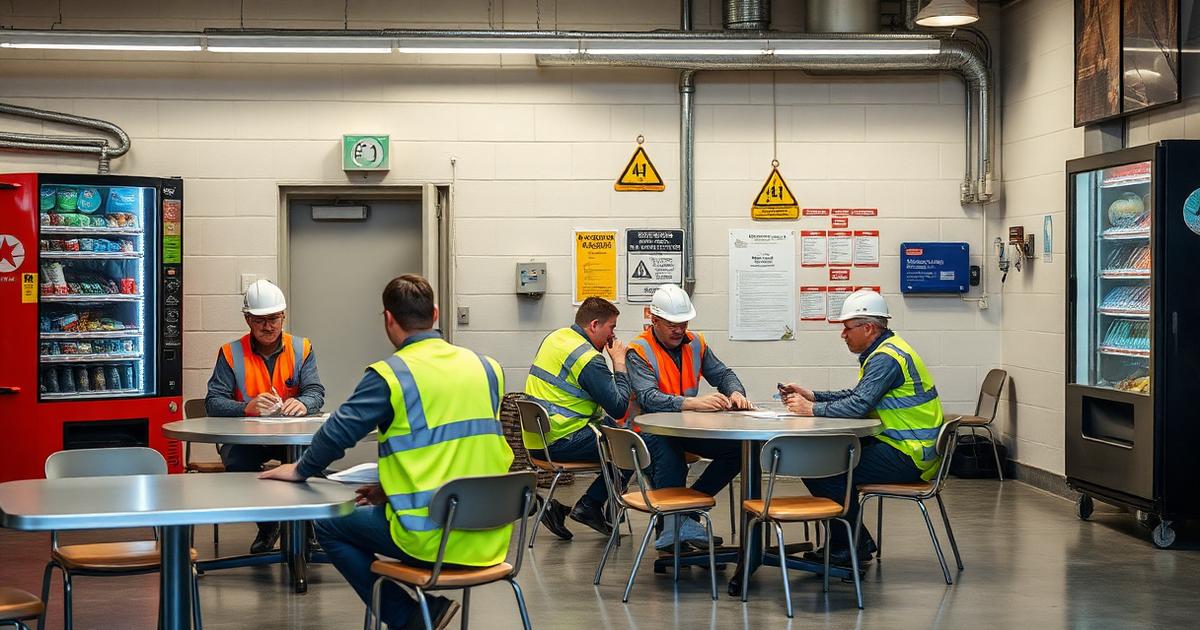
The environmental lever is amenity. If tea, coffee, cold drinks, snacks and light meals are available where people already are, a meaningful share of off-site trips simply do not occur. That is not a legal defence and should never be sold as one; it is exposure reduction of the same kind as putting a printer on the floor people work on.
- Keep documented break rosters and site access records
- Provide mobile-friendly incident reporting with same-day capture
- Brief supervisors that off-site recess injuries are still reportable
- Reduce the number of trips that need to happen by improving on-site amenity
- Review claims quarterly by cause, not just by cost
Does on-site food and drink reduce claim exposure?
Directionally, yes — fewer trips across a road is fewer opportunities to be struck or to fall. Honestly, though, no vending supplier can quantify that for your site, and any supplier who quotes you a percentage reduction is guessing. What can be measured on your own numbers is trip frequency: how many staff leave the building during breaks now, and how that changes once cold drinks, snacks and coffee are available on the floor.
This is where the economics tend to surprise facilities managers. A workplace vending machine placed under $0 COST hire carries no purchase price, lease, rental, insurance or service fee. A local owner-operator supplies, delivers, installs, stocks and services the machine, and the site provides roughly one square metre of floor space and a standard 240V outlet. Sites from about 15–20 staff typically qualify, and the machine is removed free of charge if it does not suit either party.
The only running cost the site carries is electricity, at roughly 1.2–2.5 kWh a day for a refrigerated unit, or about $0.35–$0.80. Against a single lost-time claim and its premium consequences, that is a rounding error — but it should be presented internally as an amenity and convenience decision with a plausible safety benefit, not as a compliance control.
How should this be documented in a WHS system?
Keep the framing accurate. Record the amenity change as a workplace welfare and convenience improvement in your consultation minutes, note the rationale — reducing the volume of discretionary off-site trips during breaks — and leave the legal characterisation of any future claim to the insurer.
Pair it with the administrative controls that actually shift outcomes: rostered break clarity, prompt reporting, and a return-to-work process that engages in the first week. In New South Wales, early intervention on a recess claim behaves much like early intervention on any other claim; the difference is that the facts are usually thinner, so the value of a same-day report is higher.
Finally, review the position annually. Legislation, scheme guidance and case law all move, and a 2026 summary should not be relied on in isolation for a 2028 decision.
Where does this sit in a 2026 facilities budget?
Most New South Wales facilities budgets already carry line items for amenity — kitchen consumables, water, occasionally a coffee service. Vending placed at no cost changes the arithmetic, because the amenity arrives without a capital request, a lease approval or an ongoing service charge.
For a Sydney CBD tenancy, the practical constraints are dock booking and after-hours restocking access. For a Western Sydney or regional New South Wales site, it is usually floor space near the crib room and a spare power outlet. Both are solvable in days rather than months, which is why this is one of the few risk-adjacent improvements that can be delivered inside a single quarter.
Frequently asked questions
Is an injury during a lunch break covered by workers compensation in NSW?
It can be. Section 11 of the Workers Compensation Act 1987 allows injuries during an interval or authorised absence from work to be treated as arising in the course of employment, unless the absence ran for an unreasonable period or the worker voluntarily and unreasonably submitted to an abnormal risk. Leaving the premises does not automatically end coverage, so each claim turns on its own facts.
What is the difference between a journey claim and an ordinary recess claim?
A journey claim concerns travel between home and work at the start or end of a shift and is assessed under narrower rules that generally require a real and substantial connection with employment. An ordinary recess claim concerns an interval during the working day, such as a meal or rest break, and is assessed under the interval provisions instead.
Does the employer pay for a recess claim, or the cafe where it happened?
A compensable workers compensation claim is met through the employer's workers insurance policy, not by the third party where the incident occurred. There may be separate common law or public liability questions involving an occupier, but from the employer's perspective the claim flows into their own claims experience and premium calculation.
Can better on-site amenity actually reduce workers compensation claims?
It reduces the number of discretionary off-site trips during breaks, which reduces the opportunities for a footpath or road incident. No supplier can honestly quantify the claims impact for your specific site, so treat it as sensible exposure reduction and an amenity improvement rather than a compliance control or a guaranteed saving.
How much floor space and power does a workplace vending machine need?
Roughly one square metre of floor space — about 1000mm wide, 900mm deep and 1830mm tall — plus a standard 240V outlet and enough clearance for the door and for airflow behind the machine. Trolley or goods-lift access is needed for delivery and restocking, which is the main constraint in older Sydney buildings.
Does a site have to pay for the machine under $0 COST hire?
No. There is no purchase price, lease, rental, insurance or service fee. A local owner-operator supplies, delivers, installs, stocks and services the machine and earns from product sales. The site provides the space and power, staff pay only for what they buy, and the machine is removed free of charge if the placement does not suit either party.
Key claims, checked against sources
A refrigerated snack-and-drink combo machine draws about 1.2–2.5 kWh per day, so electricity is the only running cost the host site carries.
The machine plugs into a standard 240V general power outlet — no three-phase supply, plumbing or data cabling is required.
Sites from about 15–20 daily staff typically qualify for $0 COST hire placement through a local owner-operator.
Sources and further reading
- SafeWork NSW — workplace health and safety regulator
- icare NSW — workers insurance and claims
- icare NSW — making a workers compensation claim
- SafeWork NSW — employer legal obligations
- Machines Vending — $0 COST placement
- Vending machine power consumption guide
- Sydney placement coverage